Understanding Property Tax Bills in SW Florida (with an emphasis on Cape Coral, FL)
If you’re buying a home in Lee County, Florida—especially new construction in Cape Coral—your property tax bill can look very different than what you see on the current owner’s records. Below is a clear, buyer-friendly breakdown of how Lee County property taxes work, why taxes can jump after closing, and how Cape Coral water & sewer assessments can dramatically change the yearly tax bill (and even affect loan approval).
How Property Taxes Work in Lee County, Florida (Especially for New Construction Homes)
In Lee County, your property taxes are based on what’s called a millage rate.
A mill is simply $1 in tax for every $1,000 of taxable value.
Right now, total Lee County millage typically ends up being somewhere around:
➡️ ~16 mills (or about $16 per $1,000 of assessed value)
Actual at time of writing: 15.3806 in Cape Coral / 16.5034 in Fort Myers / 13.4329 in Ft Myers Beach (etc.)
So very roughly:
- $300,000 taxable value = about $4,800/year
- $500,000 taxable value = about $8,000/year
- $750,000 taxable value = about $12,000/year
- $1,500,000 taxable value = about $24,000/year
This can vary depending on location (City of Cape Coral vs unincorporated Lee County, fire districts, school board, etc.), but that’s a realistic ballpark buyers can use when estimating Cape Coral property taxes or Fort Myers property taxes.
The #1 Thing Buyers Need to Know: Taxes Are Re-Assessed After You Buy
When you purchase a home in Lee County…
👉 The property will be reassessed.
Many buyers look at the current owner’s tax bill and assume:
“Great! Taxes are only $2,200 per year!”
But if that owner bought the home:
- 10 years ago
- 20 years ago
- or even 5 years ago
…and has had a Homestead Exemption in place, their taxable value may have been increasing by only:
✔️ 3% per year under Florida’s Save Our Homes Cap
So their tax bill may be based on a value from 2008, 2012, or 2016 that has only slowly crept up since.
Meanwhile…
You buy the home in 2026, and now the Lee County Property Appraiser resets your assessed value based on the current market.
Assessed Value ≠ Purchase Price (And This Surprises People)
A very common belief is:
“They always reassess at whatever I paid.”
Not exactly.
Lee County Property Appraiser (LEEPA) typically determines value using:
➡️ Recent comparable sales (comps)
- If you got a great deal but nearby homes sold for more
🔺 You could be assessed higher than what you paid - If you overpaid in a competitive situation
🔻 You could be assessed lower than what you paid
It’s based on the market — not strictly your contract price.
You can learn more about how exemptions work here:
Lee County Property Appraiser – Exemptions
Or estimate future taxes using their estimator tool here:
LEEPA Parcel Lookup (then click “Tax Estimator”)
Tip: Look up any property and then at the top right click “Tax Estimator”. Enter a potential sales price & it will calculate. If you already own in Florida with a homestead exemption, you can also enter portability information there as well.
Why New Construction Property Taxes in Cape Coral Are Often Higher
This is where many buyers building in:
- NW Cape Coral
- SW Cape Coral
- Burnt Store area
- Punta Gorda Isles
- Babcock Ranch
- Lehigh Acres
…run into surprises.
When you see a new construction home with:
“Estimated taxes: $2,100/year”
That tax bill is often based on:
🚫 Land only (before the house was built)
Once the home is completed, the following year’s tax bill will now include:
- ✔️ Land value
- ✔️ Structure value
- ✔️ Improvements
So that same home may jump to:
➡️ $5,000 – $9,000+ per year depending on value
Because now the county is assessing a fully completed $400K–$800K+ home — not a vacant lot.
Homestead vs Non-Homestead Owners in Lee County
If you make the home your primary residence and file for:
✅ Florida Homestead Exemption
You receive:
- A reduction in taxable value
- AND a 3% annual cap on assessment increases
If you do not homestead (second home, rental, investment property):
Your assessed value can increase by:
➡️ Up to 10% per year
So two identical homes in Cape Coral could have very different taxable values and very different tax bills…depending on when they were purchased and whether they are homesteaded.
More info here:
https://leepa.org/Exemption/GeneralExemptionInfo.aspx
Real-World Example
Buyer A:
- Bought in 2005 for $220K
- Homesteaded
- Assessed value slowly rose with 3% cap
- Current taxable value = $310K
Buyer B:
- Buys same home in 2026 for $550K
- Reassessed using current comps
- Taxable value = ~$525K
Even if both homestead… Buyer B’s starting point is much higher.
Pro Tip for Buyers Moving to Cape Coral or Fort Myers
Before you purchase, always estimate your future tax bill using:
➡️ Lee County’s tax estimator tool
This is especially important when you’re budgeting monthly payments for:
- New construction homes in Cape Coral
- Waterfront homes
- Gulf access properties
- Investment properties in Fort Myers
Because your lender’s estimate is not always based on the future assessed value.
Understanding how Lee County Florida property taxes, new construction tax reassessments, and the Homestead Exemption Save Our Homes cap work can help you avoid surprises — and budget confidently for your future in Southwest Florida.
In the strange ecology of local finance, the tax bill is less like a static number and more like a living organism that evolves when ownership changes. Treat it as a forecast, not a fossil, and your closing day math will line up much better with reality six months later.
Cape Coral Water & Sewer Assessments (Why Two Identical Homes Can Have Very Different Tax Bills)
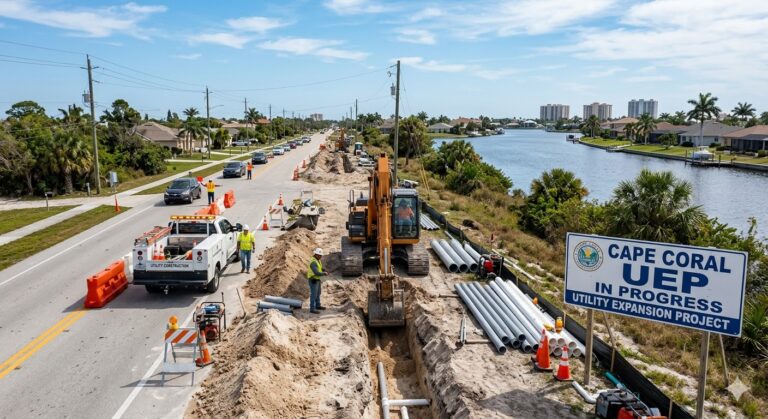
Cape Coral is still in the process of expanding city utilities (water, sewer, irrigation), and when these Utility Extension Projects (UEP) are completed in an area, the cost to install those services is assigned to each property as an assessment.
Typically somewhere in the ballpark of:
➡️ $30,000 – $40,000 per property
Now here’s where things get interesting.
Homeowner A may choose to:
✔️ Pay that assessment off in full once utilities are installed
Homeowner B may choose to:
✔️ Finance that same amount over time
If they finance it, that balance shows up as an annual installment on their Lee County property tax bill.
So now:
🏠 House 1 next door
🏠 House 2 next door
Same:
- square footage
- year built
- canal access
- pool
- upgrades
- neighborhood
…but:
- House 1 has a $5,200/year tax bill
- House 2 has a $7,900/year tax bill
Why?
Because House 2 is still paying off a financed water & sewer assessment through their tax bill.
Same house. Same street. Totally different taxes.
And yes — this happens all the time with newer construction homes in Cape Coral and homes located in recently completed utility expansion areas.
More info from the City here:
City of Cape Coral – Utility Extension Project (UEP)
The Loan Qualification Curveball (DTI Can Be Affected)
When you’re obtaining financing, your lender looks at your:
➡️ Debt-to-Income Ratio (DTI)
And one of the biggest monthly obligations factored into your DTI is:
✔️ Your estimated property tax payment
Here’s the catch:
Even if you negotiate for the seller to pay off the water & sewer assessments at closing… if they are currently financed on the tax bill:
👉 Your lender will often still use the current tax bill amount when qualifying you for the loan.
Meaning:
- You might be planning for seller payoff and a lower future tax bill…
- …but underwriting is working with today’s higher tax bill (including financed assessments).
In tighter scenarios, this can:
- ❌ Reduce your approved purchase price
- ❌ Require a larger down payment
- ❌ Change loan program eligibility
- ❌ Or in some cases… break the deal entirely
Even though the assessment is being paid off at closing.
Timing Matters When Paying Off Utility Assessments
Per the City of Cape Coral:
- Annual installments are calculated during August and September each year.
- If payoff is made after July 31, an annual installment will automatically be billed on your property tax bill.
- Upon payment in full of both the annual installment (to the Lee County Tax Collector) and the remaining principal balance (to the City of Cape Coral), the assessment will no longer appear on the tax bill.
Why This Matters When Buying a Home in Cape Coral
Between:
- Reassessments after purchase
- Homestead vs non-homestead caps
- New construction being taxed as land only initially
- And financed water & sewer assessments
Two nearly identical homes in Cape Coral can have dramatically different:
- Annual property taxes
- Monthly mortgage payments
- Loan qualification outcomes
This is why we always recommend buyers moving to Southwest Florida — especially those purchasing new construction homes in Cape Coral or homes in utility expansion areas — review:
- ✔️ Current tax bill
- ✔️ Homestead status
- ✔️ Assessment balance
- ✔️ Estimated reassessed value
Before finalizing budgeting or financing assumptions.
In the bureaucratic ecosystem of municipal infrastructure, assessments are basically Schrödinger’s bill — they both do and don’t exist until your underwriter opens the file. Understanding how they interact with Lee County property taxes keeps your purchase math grounded in reality instead of wishful spreadsheet alchemy.
A Note on Florida Statutes & “No Property Taxes” Rumblings
You can read the Florida statute here:
https://www.leg.state.fl.us/Statutes/index.cfm?App_mode=Display_Statute&Search_String=&URL=0600-0699/0689/Sections/0689.261.html
And you may have heard rumblings of the property tax bill being removed for homesteaded properties. Our current Governor, Ron DeSantis, has been speaking about this being added to an upcoming ballot for vote. We shall see, but for now yes, we do have to budget for our property tax bills.
But don’t forget: depending upon where you may be moving from, you may be saving with no state income tax in Florida.
Need Help Estimating Taxes Before You Buy?
If you have any additional questions, we are here to help you.
Ready to go home shopping now? Here are some of our most popular home searches ready for you (or you can create your own home search here):