What It’s Really Like to Live in Cape Coral, Florida (2025 Relocation Guide)
If you’ve been thinking about moving to Cape Coral, FL but want to know the REAL 4 1 1? Learn what it’s really like to live here from a LOCAL; neighborhoods, canals, weather, cost of living, schools, hurricanes, critters and more. What does it really cost to live in Cape Coral, FL? Keep reading for all of those burning questions and more about living in working in Cape Coral Florida.
What It’s Really Like Living in Cape Coral, Florida
A local-style guide for anyone thinking about relocating to the city of Cape Coral, Florida USA
If you’re considering a move to Cape Coral, Florida, you’re probably seeing phrases like “Waterfront Wonderland” and photos of homes with boats parked in the backyard and wondering:
Okay, but what is day-to-day life actually like there? Is it safe? What about hurricanes, schools, critters, and cost of living?
This guide is written to answer the questions most relocators ask and to give you a realistic, encouraging overview of life in Cape Coral from a real long time resident.
1. Big-Picture: Where You’re Moving & Who Lives Here in Cape Coral FL
Cape Coral sits on Florida’s Gulf Coast in Lee County, directly across the river from Fort Myers. It’s the largest city in Southwest Florida and the largest city between Tampa and Miami, with roughly 210k+ residents and growing fast.
A few things that immediately stand out:
Water everywhere. Cape Coral has 400+ miles of navigable canals, more than any other city in the world – the reason for the nickname “Waterfront Wonderland.”
Suburban feel, coastal lifestyle. Think single-family homes, wide streets, lots of new construction, and a laid-back vibe.
Growing & diversifying. The city’s population has grown about 25–30% since 2010 and continues to attract both retirees and younger families/remote workers.
If you like sunshine, water, and a quieter feel than Miami or Tampa but still want access to shopping, dining, healthcare, and airports, Cape Coral hits that sweet spot.
If you’re thinking about moving to Cape Coral and want personalized guidance, contact our team
to talk through your plans.
2. How Cape Coral Is Laid Out (Quadrants, Canals & Bridges)
Cape Coral is big, so understanding the layout really helps when you’re house-hunting:
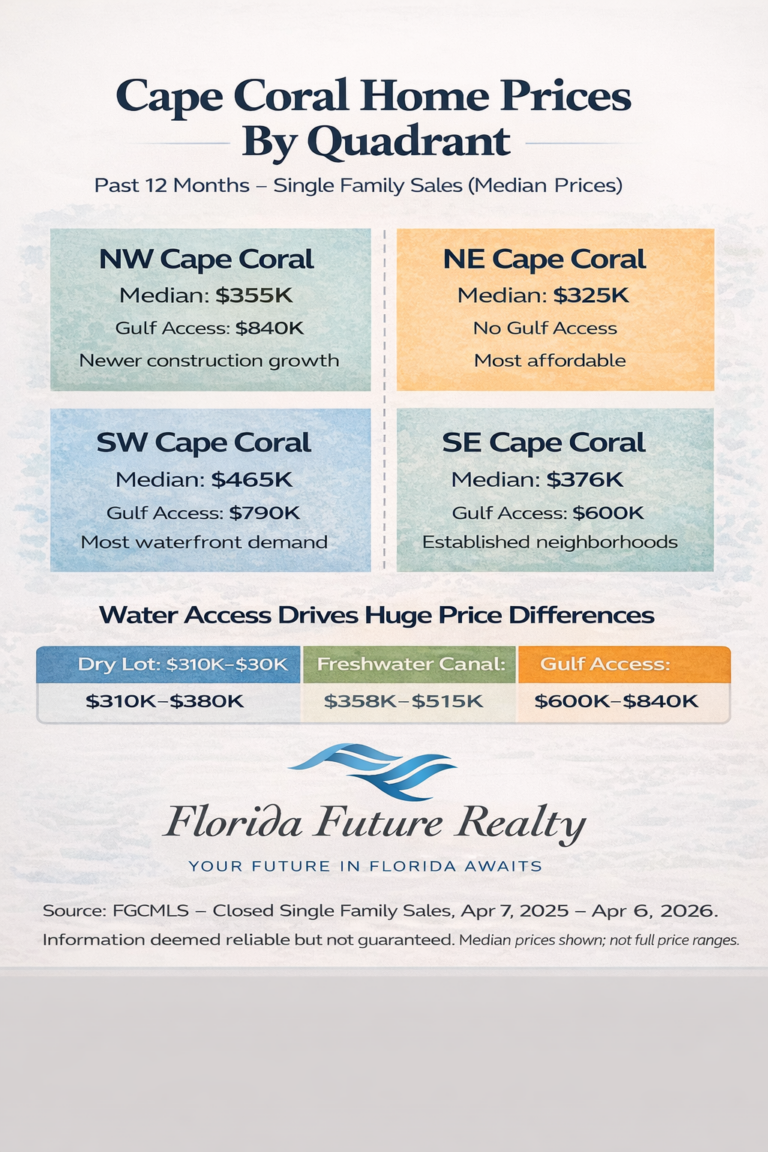
The city is divided into four main quadrants (SW, SE, NW, NE) using Santa Barbara Blvd (north–south) and Cape Coral Pkwy / Hancock Bridge Pkwy/Embers Pkwy (east–west) as rough dividing lines.
Canal types:
Gulf access / sailboat access canals: No bridges or only high bridges between you and open water; great if you’re a serious boater. Canal depths can vary so if you have a very large vessel that pulls a lot of draft then we can help guide you to canals that will be a good fit.
Gulf access with bridges: You can reach the river/Gulf, but bridge heights matter if you have a tall boat. Some bridge heights are 7-8 feet and others 9-10 feet but tides can alter this a bit as well.
Freshwater canals & lakes: No Gulf access, but you can fish, kayak, or cruise within the freshwater system.
Dry / Off Water lots: No canal, usually lower purchase price and lower maintenance. If you don’t NEED to be on the water your dollars will go much further here!
To leave the Cape and head to Fort Myers, you’ll typically use:
Cape Coral Bridge (across to College Pkwy)
Midpoint Memorial Bridge (Veterans Pkwy to Colonial Blvd)
North Downtown Bridge (To Downtown Ft Myers) (bonus this bridge doesn’t have tolls)
Both bridges charge electronic tolls westbound only (coming into Cape Coral), currently around $2 with a transponder.
3. Weather & Seasons: What It Actually Feels Like year round in Cape Coral Florida
Cape Coral is subtropical, which means:
Winters (Nov–April):
Generally gorgeous: sunny, dry, mid-70s to low-80s most days.
This is “season” when snowbirds arrive.
This is when our area really shines in terms of the BEST weather!
Summer (May–Oct):
Hot and humid, often 90°F+ with a “feels like” temp higher.
Regular afternoon thunderstorms and our rainy season.
Sunshine:
The area averages 350+ days of sunshine per year, so if you love bright sunny days, you’ll be very happy here.
You’ll want good AC for sure – probably a POOL, light clothing, and to get used to doing yard work, walks, and outdoor errands earlier in the day in summer.
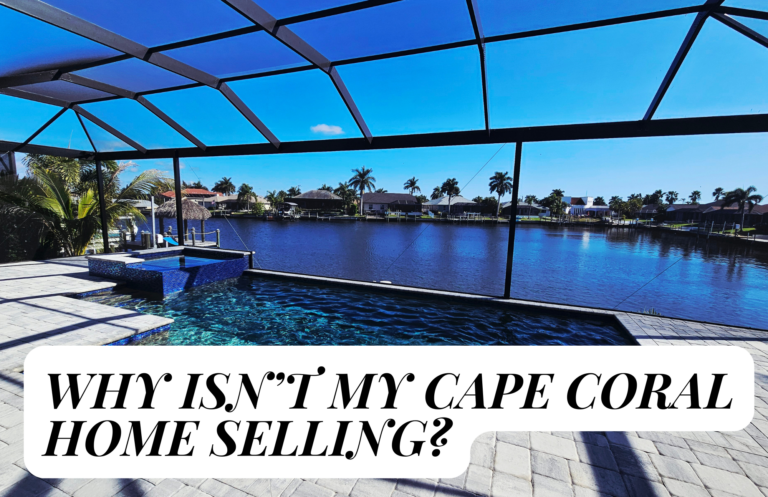
Already own a home in Cape Coral and considering a move? Learn how we help homeowners sell for top dollar on our Cape Coral home selling page now.
4. Cost of Living & Housing in Cape Coral
One of the big questions relocators ask: “Is Cape Coral affordable?”
Overall cost of living: Slightly above the U.S. average and a bit higher than the Florida average, mainly because of housing and insurance.
Housing:
Still often more affordable than many other Florida coastal cities, especially when comparing waterfront to waterfront.
You’ll find everything from modest 1960s–80s homes to brand-new construction, luxury waterfront, and 55+ communities.
At the time of writing, the average price of a home in Cape Coral is $425,260. With the wide range of prices though you can expect to find a great starter home under $300,000 or a luxury waterfront estate into the millions. Truly something for every price point!
Taxes:
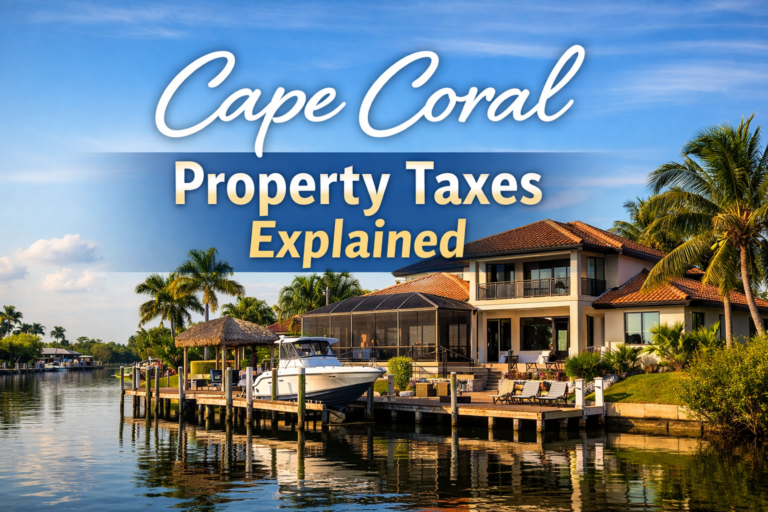
Florida has no state income tax, and full-time residents can use the Homestead Exemption and Save Our Homes cap to help manage property taxes long-term. There are currently discussions about a possibility of no property taxes for full time residents but nothing has been passed yet.
Insurance:
Homeowners and flood insurance costs have decreased in the past 2 years across Florida after the uptick right around Hurricane Ian; see the hurricane/insurance section below for more detail.
If you’re coming from high-cost states (parts of the Northeast, California, Chicago, New York, etc.), you may find Cape Coral comparatively reasonable. If you’re moving from the Midwest or smaller inland cities, it may feel like a step up in price, but with a big lifestyle upgrade. I.E. No more shoveling snow! Sound good? Ready to start looking at homes? You can explore Cape Coral homes and resources here
5. Assessments in Cape Coral
You may heard about assessments in Cape Coral, Florida but what exactly does that mean?
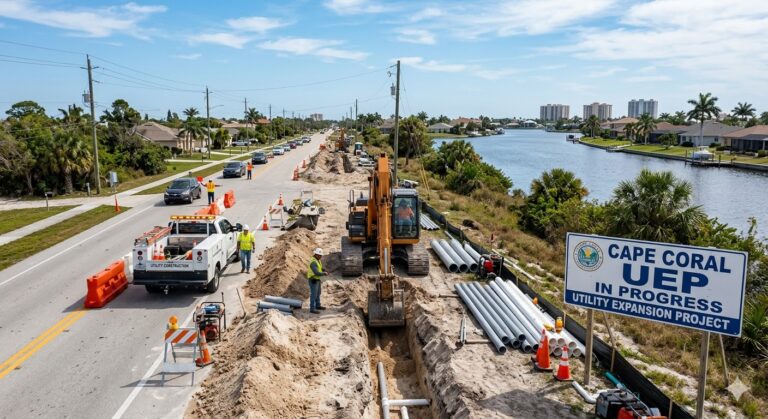
Well, over the years the city of Cape Coral has worked to expand central water & sewer throughout the city. Most of the homes in the NE and NW quadrants are still, at the time of this article being written, on well & private septic systems. There are pros and cons to being on private systems. You won’t have a direct water bill but you will need to maintain your own systems. There have also been recent issues with low water tables and some wells actually running dry.
Costs of Assessments
When water & sewer does come into an area you have the option to pay for it upfront but due to the high costs (30-40K in recent years per home) many homeowner opt to finance this amount into their tax bill.
Homeowners are also required to pay for a licensed and approved plumber to connect their home as well. This explains why sometimes you’ll see such varying amounts on tax bills as well. We can help you make sense of these discrepancies – whether its a new build, a long term homesteaded property or recent addition of water, sewer & irrigation expenses.
6. Safety & Crime throughout Cape Coral FL
Safety is another top question for families and retirees.
Cape Coral is consistently rated safer than the average U.S. city for both violent and property crime. You can learn more with some quick online searches as we cannot get into those details here.
The Cape Coral Police Department reported about a 28% decrease in overall crime in the first half of 2025 compared to 2024, which is a strong trend in the right direction. Cape Cops head over to check stats directly with our local Police Dept here in Cape Coral, Fl.
Of course, crime exists everywhere, but many new residents are pleasantly surprised by how comfortable they feel going for evening walks, visiting parks, and living in quieter residential neighborhoods.
7. Schools & Raising a Family in Cape Coral
Cape Coral is part of the School District of Lee County, which uses a “school choice” zone system rather than strict neighborhood-only zoning: families rank their preferred schools within their assigned choice zone. We wrote more about the Lee County School choice here!
A few key points:
There are dozens of public, charter, and private schools serving Cape Coral, including specialized academies and programs.
Many local schools receive solid ratings on sites like Niche and GreatSchools; like most cities, quality can vary by specific campus, leadership, and programs.
Families often choose areas based on:
Proximity to certain schools
Commute patterns (bridges, main corridors)
Lifestyle (waterfront vs interior neighborhoods, HOA vs non-HOA)
Beyond schools, families appreciate:
Lots of parks & playgrounds
Sun Splash Waterpark, one of the largest in SW Florida
Youth sports, after-school programs, parks across the city, and nearby beaches.
8. Work, Commute & Everyday Errands around Cape Coral
Jobs & income
The local economy is anchored by:
Healthcare and medical services
Construction and trades
Education and government
Retail, hospitality, and real estate
Many residents also:
Commute to Fort Myers or nearby areas for work.
Work remotely from home thanks to decent internet availability in most neighborhoods.
Driving & traffic
Cape Coral is car-dependent; you’ll want a vehicle.
During “season” (roughly Jan–April), traffic can be heavier, especially near major shopping areas and bridges.
Tolls are only charged westbound into Cape Coral on the Cape Coral and Midpoint bridges, so commuting off the Cape in the morning and back in at night means you pay coming home. Most of us full time residents purchase a transponder and save a little with that. If you go over the bridges without one you’ll get a bill (plus admin fee) in the mail.
9. Hurricanes, Flood Zones & Insurance (Important for Cape Coral!)
Southwest Florida could be affected by Hurricanes, and Cape Coral is no exception. Understanding risk and insurance is crucial when you’re deciding where to live. Not everyone is interested in “dealing” with this possibility.
We feel like there’s weather concerns everywhere and like that we usually have a lot of time to prepare before a Hurricane ever makes its way near us.
Flood zones
FEMA maps classify areas into zones such as AE, VE (higher risk) and X (lower risk).
Lenders generally require flood insurance if your home is in a higher-risk zone, which adds to your monthly costs.
Even in “low-risk” zones, local insurance experts often recommend flood coverage; a significant portion of flood claims nationwide come from outside high-risk zones.
Insurance reality
Standard homeowners insurance does not include flood.
Premiums have come slightly back down since the increases a few years ago in many parts of Florida. New companies have moved into the state as well.
When you’re shopping for homes, it’s wise to:
Ask for the current homeowners and flood insurance premiums.
Check the home’s flood zone and any prior claim history. Many owners flood insurance policies can be assumed by the new owner potentially saving a lot of money on the premium.
Factor hurricane shutters, impact windows, home age, electric and plumbing updates if the house is old and roof age into your decision. Discounts are available for many upgrades so it’s important to research and get a full home inspection and 4 pt & wind mitigation as well.
Preparedness is simply part of living here: you keep a hurricane kit, watch the tropics in season, maybe purchase a generator, and have a plan. Most long-time residents will tell you the lifestyle still far outweighs the risk, but it’s something to go into with eyes open.
10. Lifestyle: Boating, Beaches, Nature & Things To Do in and Around Cape Coral FL
If you’re moving for quality of life, here’s where Cape Coral really shines.
On the water
With 400+ miles of canals, Cape Coral is a dream for boaters, kayakers, and anglers.
Many homes have private docks; others use neighborhood or city boat ramps.
You can access:
The Caloosahatchee River and out to the Gulf of Mexico
In SW get out directly near Shell Point from Cape Harbour or Tarpon Point Areas
Nearby islands like Sanibel, Captiva, Pine Island, and Cayo Costa (some still rebuilding but still beautiful destinations).
From NW Cape Coral you’ll exit out near Matlacha and can head up to Charlotte Harbour
Nature & parks
Four Mile Cove Ecological Preserve: boardwalks through mangroves and kayak trails.
Rotary Park – one of our favorites in SW Cape Coral with great walking paths, playground, butterfly house, dog park & event unique events.
Multiple other city parks with walking paths, playgrounds, tennis, pickleball, boat launches, and dog parks.
Golf options in and around Cape Coral and Fort Myers – and a bit further out Bonita Springs, Naples & Sarasota have some fabulous gold course options.
Dining, shopping & entertainment
Local restaurants (waterfront tiki bars, seafood, casual dining).
Big-box shopping and chain options along Pine Island Rd, Del Prado, and Veterans.
A growing local scene with farmers markets, events, and community festivals.
The overall feel is relaxed, community-oriented, and coastal – more “live where others vacation” than big-city nightlife. If a more exciting night life is important to you most head over to Ft Myers and hit the bars, restaurants and clubs there in their more vibrant night life scene.
11. Common Questions About Moving to Cape Coral
“Is Cape Coral good for retirees?”
Yes. One-story homes, abundant healthcare providers, mild winters, and plenty of social activities make it popular for retirees. Many 55+ communities and golf communities cater to this group. Just remember, people don’t retire here to sit still. Everyone here – even in their 100s are ACTIVE.
“Is Cape Coral good for families?”
Also yes. There are family-friendly neighborhoods, parks, sports, and schools, and crime levels are relatively low. The trade-off is that you’ll drive most places; it’s not a very walkable city overall. We do offer a lot of bike paths but usually commute via car. There are some buses but its not as popular as some other areas.
“What about bugs, heat, and wildlife?”
You will see palmetto bugs, mosquitoes (especially in rainy season), and the occasional lizard or small gator in or near water. Most people adjust quickly with screens, pest control, and common-sense awareness. Again, it gets warm and humid in the summer so plan accordingly.
“How far is the beach?”
Cape Coral has a small “beach” area at Yacht Club (currently in redevelopment), but the classic Gulf beaches—Fort Myers Beach, Sanibel, Captiva, Bonita—are an easy drive, traffic depending. Or you can boat there as well!
“Speaking of boats, will I need a boat to enjoy living there?”
No—but if you enjoy the water, you’ll be tempted. Many residents are perfectly happy enjoying community pools, canalside walks, parks, and day trips to the beach without ever owning a boat. There are also a few boat rental companies and boat club memberships. We recommend this to a lot of newcomers so they can determine the right type of boat for their new Cape Coral lifestyle.
Want to know more about us? Learn more about who we are and how we work on our About Florida Future Realty
12. Is Cape Coral Right for You?
Cape Coral might be a great fit if you:
Want sunshine, water access, and a slower, coastal pace of life
Like the idea of a single-family-home community rather than a dense city
Are okay with driving, planning for hurricane season, and learning about flood zones and insurance?
If you’re a serious boater, beach lover, or someone who wants to feel like they’re “on vacation at home,” it’s hard to beat.
We’d love to help you find your dream home! Your Future in Florida awaits. You can reach an agent or start your home search with one of the quick links below. We can’t wait to meet you!
Southwest Florida Real Estate, Refined
Work With
Florida Future Realty
Tell us about your plans to move, buy, or sell in SW Florida and we’ll help you map out your next steps.